
LESSON 1 – Introduction and ECG Norms
I tried to do everything to make the learning process as simple and understandable as possible, but you will also need to make certain efforts. The key to successful ECG mastering is a clear knowledge of the norms. If you master the rules, then this is already 90% of success, the remaining 10% are nuances and experience that you will get during the training process. I recommend that you also prepare paper and a pencil, as well as a calculator, sometimes you will have to do some calculations.
I understand that memorizing a lot of information, especially that you do not understand, is a difficult and boring task, so I will not force you to cram the rules in one go, this is not our approach. But if your memory can do it, it would be great. Nevertheless, I assure you that at this stage it is possible to simply learn to use the “cheap leaf” that I have prepared for you. You can print it out or simply rewrite it yourself, but the main thing is that you can navigate in it so that you find the answer in a matter of seconds. Over time, one way or another you will be forced to remember all the rules, but we will do it gradually. And now trust me and just always keep the “cheat sheet” in front of you when you start a new lesson.
ECG NORMS (FOR A RESTING ECG!)
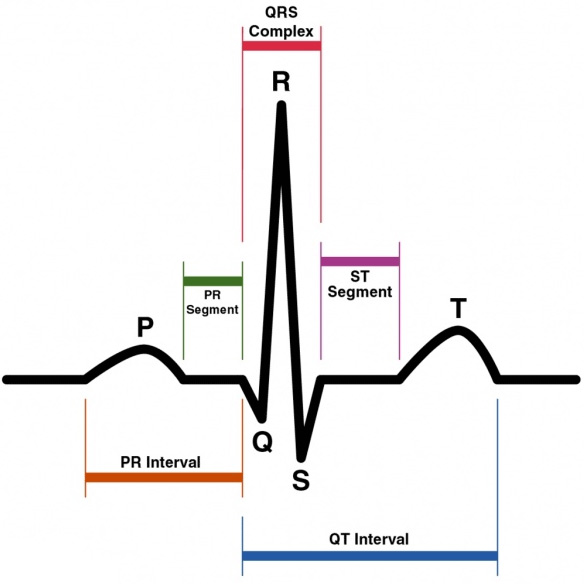
PR(Q) interval
- Duration 0.12-0.2 s.(6-10 mm at a recording speed of 50 mm/sec and 3-5 mm at a recording speed of 25 mm/sec).
R wave
- “+” in leads I, II, AVF, V4-V6.
- “-” in the aVR lead.
- Duration up to 0.1-0.12 s. (5-6 mm at a recording speed of 50 mm/sec and 2.5-3 mm at a recording speed of 25 mm/sec).
- Amplitude 1.5-2.5 mm.
QRS complex
- Duration 0.06-0.1 c. (3-5 mm at a recording speed of 50 mm/sec and 1.5-2.5 mm at a recording speed of 25 mm/sec).
Q wave
- “-” aVR; sometimes in aVL, V1 (when the EOC deviates to the left); often in III.
- Duration (except aVR!) up to 0.03-0.04 s. (1.5-2 mm at a recording speed of 50 mm/sec and 0.75-1 mm at a recording speed of 25 mm/sec).
- Amplitude up to ¼ R. Krome aVR.
| Localization of myocardial scar | |
| Localization | ECG leads |
| Septum | V1–V2 |
| Apex | V3–V4 |
| Anterior wall | V1–V6 |
| Lateral wall | I, aVL, V5, V6 |
| Inferior wall | II, III, aVF |
R wave
- Amplitude increase in chest leads RV6<RV5<RV4> RV3> RV2> RV1
ST segment
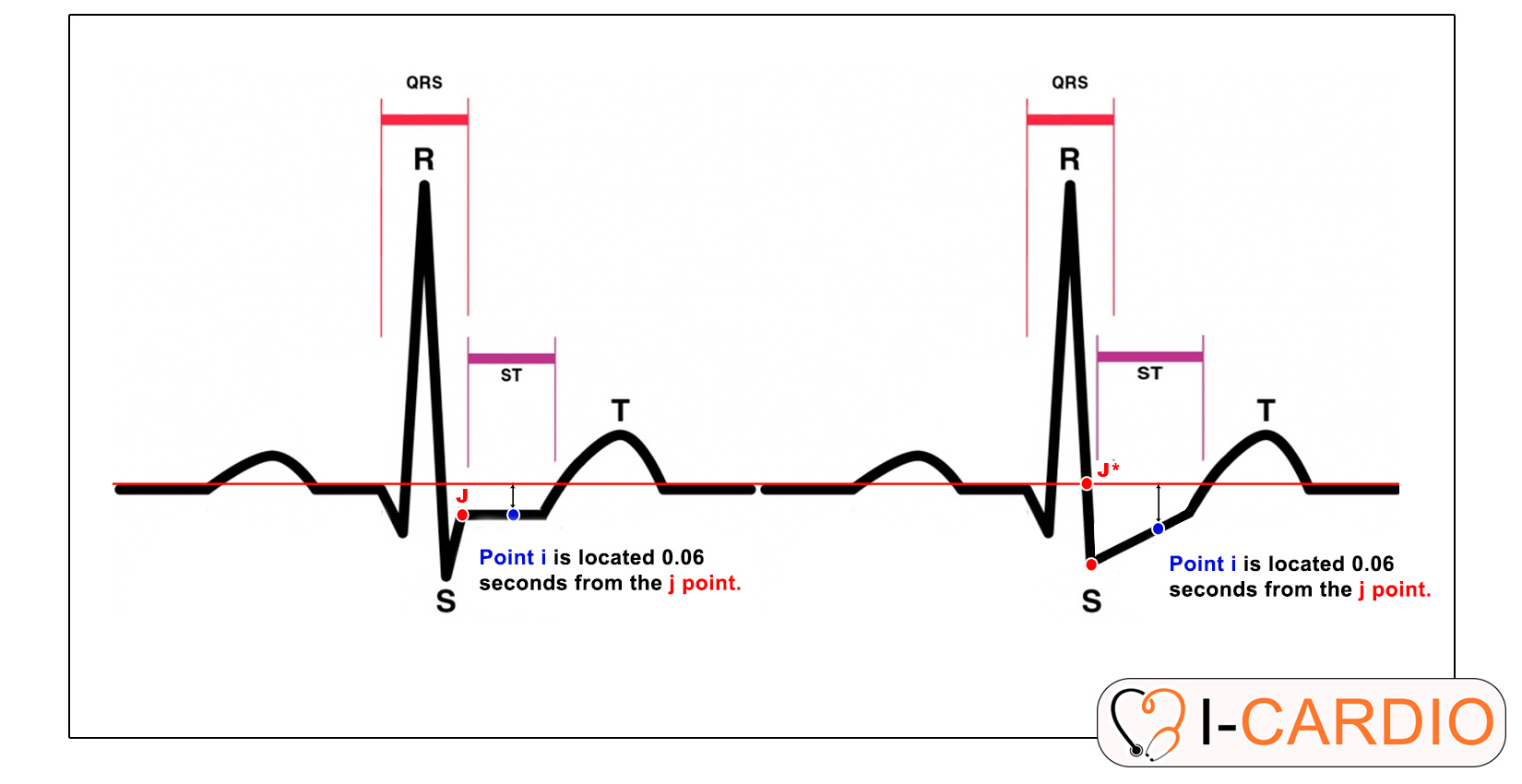
- Depression no more than 0.05 mV (0.5 mm) in any lead.
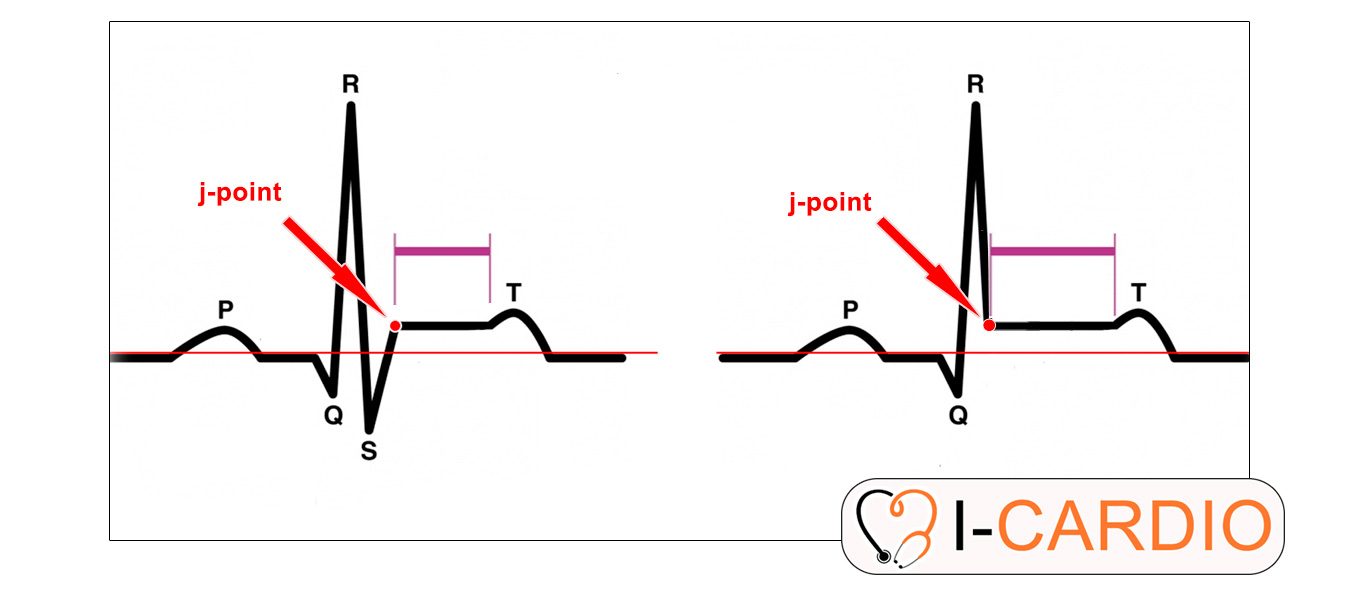
- Elevation at point J < 0.25 mV (2.5 mm) in men younger than 40 years or ≥0.2 mV (2 mm) in men older than 40 years in leads V2–V3.
- Elevation at point J < 0.15 mV (1.5 mm) in women regardless of age in leads V2–V3.
- Elevation at point J < 0.1 mV (1 mm) in the second leads (regardless of gender and age).
It is schematically shown below at which points ST depression and elevation are measured (we will talk about this in more detail in the corresponding sections).
| LOCATION OF MYOCARDIAL INFARCTION | ||
| Localization | ST elevation | Reciprocal changes |
| Antero-septal | V1–V2 | no |
| Antero-apical | V3–V4 | no |
| Anterior extensicve | I, AVL, V1–V6 | no |
| Lateral | I, AVL, V5, V6 | II, III, AVF |
| Inferior | II, III, AVF | I, AVL |
| Posterior | V7–V9 | V1–V3 |
Зубец T
- Зубец Т всегда положительный в отведениях I, II, aVF, V3-V6.
- Зубец T может быть положительным, двухфазным или отрицательным. в отведениях III, aVL и V1-V2.
- Зубец T всегда отрицательный в отведении aVR.
- Минимальная амплитуда (высота) зубца T должна быть более 1/8 – 1/10 от амплитуды зубца R (в том же отведении).
- Максимальная амплитуда (высота) зубца T должна быть < 5 мм в отведениях от конечностей, и < 10 мм в грудных отведениях (10 мм у мужчин, 8 мм у женщин).
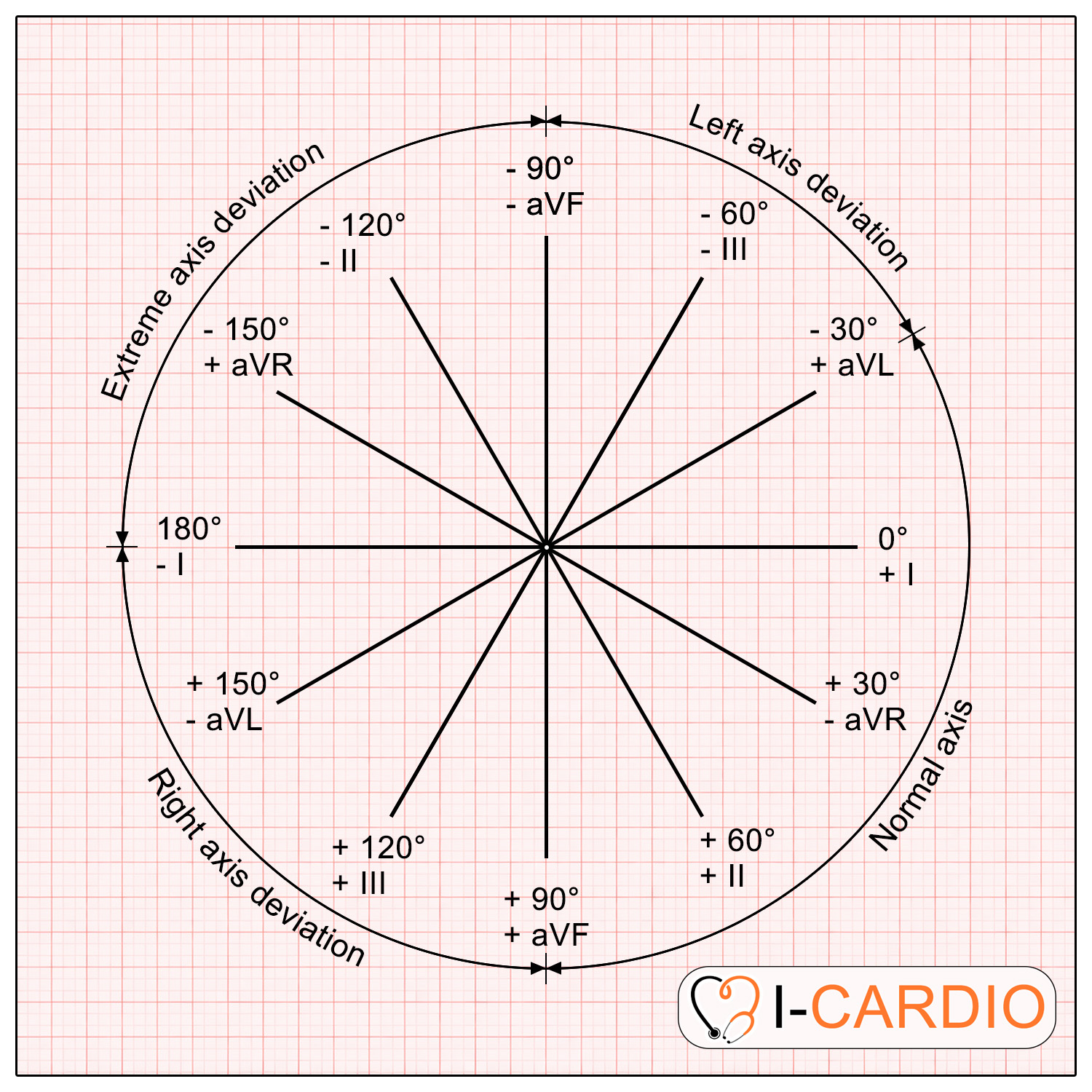
Cardiac axis
- -90° to -30° – left axis.
- -30° to + 90° – normal.
- + 91° to + 180° – right axis deviation.
- +180° to -90° – extreme deviation.
QT interval
- 340-450 msec in men and 340-470 msec in women – varies depending on the heart rate (it is necessary to calculate the corrected indicator – QTc using the formula).
- Bazette’s formula: QTc = QT/√(RR).
but for an approximate definition, the following values can be used.
- Heart rate > 100 beats. in min – up to 0.37 s.;
- Heart rate = 66-100 beats. in min – up to 0.44 s.;
- Heart rate = 44-65 beats. in min – up to 0.48 s.
Heart rate
- If the recording speed is 50 mm/sec, then HR = 3000/ RR (in mm).
- If the recording speed is 25 mm/sec, the heart rate = 1500/ RR (in mm).
So, forward for knowledge.