
LESSON 10 – Supraventricular Rhythm
Within the scope of this course, we will not go into detail regarding the various types of supraventricular rhythms (right atrial, left atrial, junctional, low atrial, coronary sinus rhythm, etc.). These are well described in specialized literature.
For you, as a non-cardiologist physician — and this course is specifically designed for this group — it is sufficient to remember that all rhythms originating above the bifurcation of the bundle branches are considered supraventricular.
They are generally characterized by the following (simplified rules):
- A regular rhythm with a heart rate up to 100 beats per minute.
- Presence of inverted P′ waves in leads II and aVF, located either before or after the QRS complex at a constant interval.
- In some cases, P waves may not be visible, as they can be superimposed on the QRS complex.
In essence, you observe a regular cardiac rhythm on the ECG, but instead of typical sinus P waves, you see P waves of non-sinus origin.
Let us now look at how this appears on an ECG (example of a supraventricular rhythm):
ECG
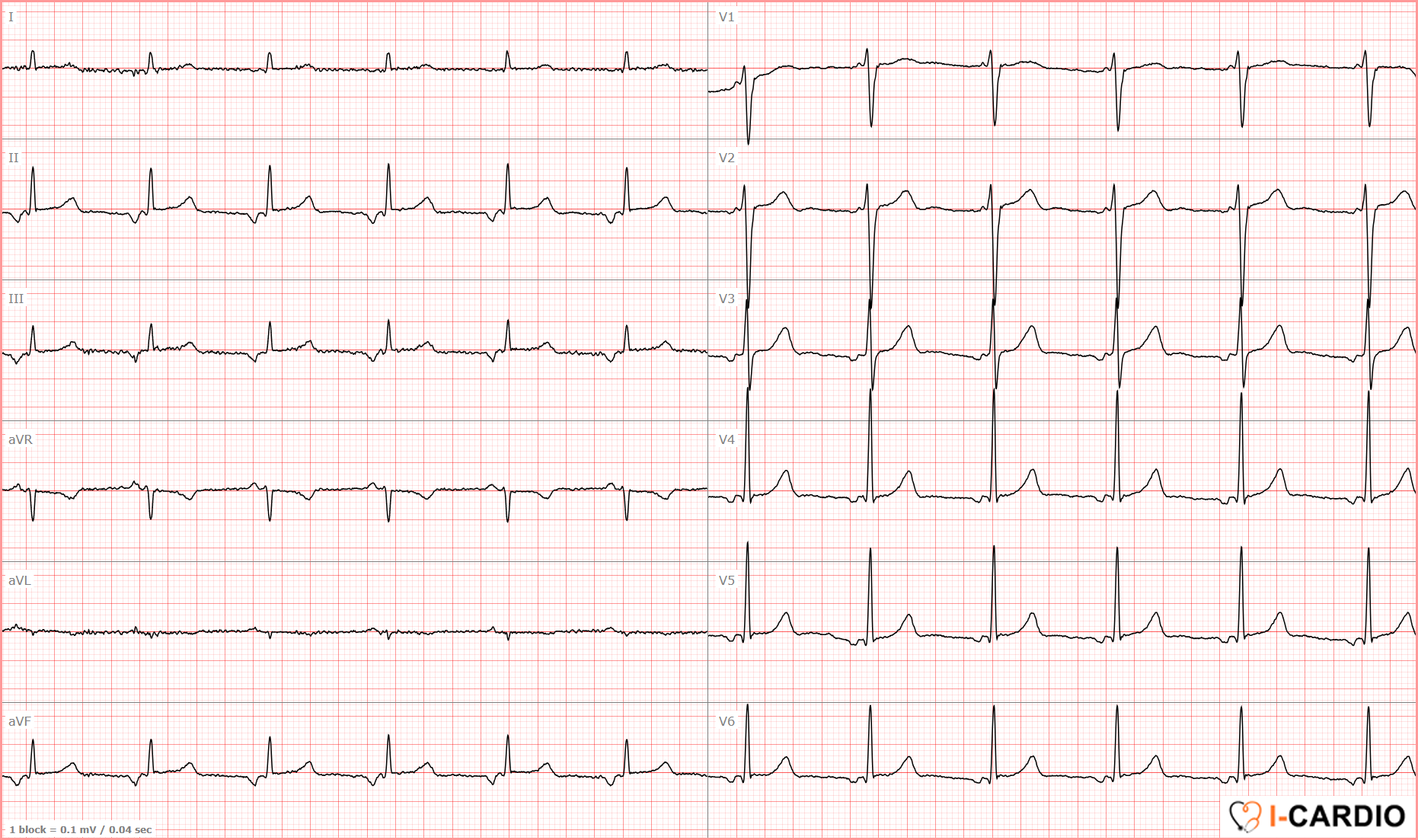
On this ECG, inverted P′ waves in leads II are seen preceding the QRS complexes. If you recall the criteria for sinus rhythm, P waves in these leads should always be positive.
I have not included an example where P waves follow the QRS complex… perhaps 🙂 you will encounter such a case in the next self-assessment task on this topic.